
Google Core Updates Explained
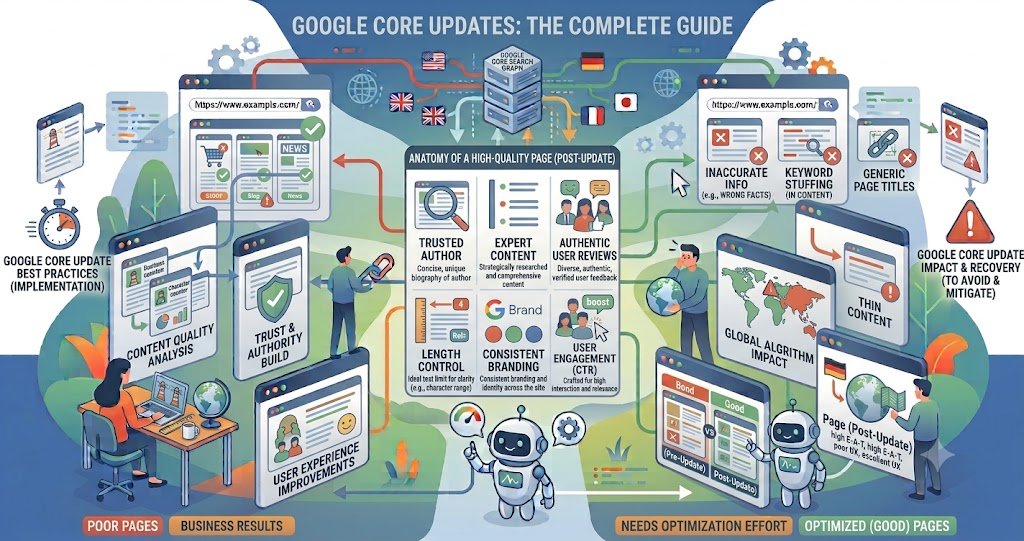
Every few months, website owners watch their traffic swing up or down for no obvious reason — and the culprit is usually a Google core update. Understanding what these updates actually do (and don’t do) is the difference between panicking over normal fluctuations and making informed decisions about your content.
Table of Contents
- What Is a Google Core Update?
- How Core Updates Differ From Other Updates
- Recent Core Update Timeline
- How Long Do Core Updates Take to Roll Out?
- What to Do If You’re Hit
- Conclusion
- FAQs
Key Takeaways
- A core update is a broad change to Google’s ranking systems, not a penalty targeting a specific site.
- Google now confirms core updates through the Search Status Dashboard and its Search Central social accounts, often without a companion blog post.
- Recent core updates (March and May 2026) have caused unusually high volatility compared to earlier years.
- Rollouts typically take 1–3 weeks to fully complete; ranking shifts can continue right up to the end.
- There’s no specific “fix” for a core update — Google’s standing advice is to keep publishing genuinely helpful, people-first content.
- Recovery isn’t guaranteed at the next update; some sites take multiple update cycles to regain lost visibility.
What Is a Google Core Update?
A core update is a periodic, broad adjustment to how Google’s ranking systems evaluate content across the entire web. Rather than targeting a specific tactic or violation, it re-weighs the many signals Google uses to judge relevance, usefulness, and trustworthiness. Because so many signals shift at once, some pages that were previously under-rewarded may rise, while others that no longer meet the bar may fall — even without any changes on the site itself.
How Core Updates Differ From Other Updates
Not every ranking shake-up is a core update. Google also runs spam updates, which specifically target manipulative practices like link schemes or scaled low-quality content, and narrower system updates (helpful content signals, product review systems, and so on) that are now largely folded into the broader core algorithm. A useful gut-check: if Google links the change to a specific violation or content type, it’s likely a spam or targeted update, not a core one.
Recent Core Update Timeline
Google has picked up the pace of confirmed core updates in 2026, and several have been described by industry analysts as unusually volatile:
- May 2026 Core Update: May 21 – June 2, 2026 (about 12 days)
- March 2026 Core Update: March 27 – April 8, 2026 (about 12 days, 4 hours)
- December 2025 Core Update: December 11 – December 29, 2025 (about 18 days)
- June 2025 Core Update: June 30 – July 17, 2025 (about 17 days)
- March 2025 Core Update: March 13 – March 27, 2025 (about 14 days)
Industry trackers have described the March and May 2026 updates as two of the most disruptive back-to-back core updates in recent memory, with some analyses showing roughly a quarter of top-10 rankings dropping significantly during the March rollout alone. Neither update came with a detailed Google blog post explaining specific goals — announcements and completions were logged mainly through the Search Status Dashboard.
How Long Do Core Updates Take to Roll Out?
Rollout length varies update to update, generally ranging from under a week to over three weeks. During this window, rankings can fluctuate in phases as different parts of the system update — a dip on day two doesn’t necessarily predict where a page settles once the rollout finishes. Google’s own advice is to wait at least a full week after a rollout completes before drawing conclusions from Search Console data, comparing the weeks before the update began against the weeks after it finished.
What to Do If You’re Hit
Google has repeatedly said there’s no specific checklist to “fix” a core update impact, since a drop doesn’t necessarily mean something is technically wrong with a page. Instead, the standing guidance is:
- Avoid reactive, cosmetic changes (like updating a publish date without real new information).
- Focus on genuine content improvement: depth, accuracy, and firsthand expertise.
- Review pages against Google’s published self-assessment questions on content quality and trustworthiness.
- Be patient — meaningful recovery often aligns with a later core update, not immediately after the one that caused the drop.
Conclusion
Core updates are less about chasing a moving target and more about consistently meeting a rising bar for quality and trust. The sites that weather them best tend to be the ones already investing in genuinely useful, well-supported content rather than reacting to each individual rollout.
Frequently Asked Questions
How often does Google release core updates? Google typically releases several confirmed core updates per year, though the exact cadence varies — 2026 has already seen updates in March and May.
Will my rankings recover after a core update? Not automatically. Recovery, if it happens, is usually tied to demonstrated improvements in content quality being reflected in a subsequent update.
Is a core update the same as a penalty? No. Google explicitly states core updates aren’t penalties against specific sites; they’re a broad recalibration of ranking systems.
How do I know if a core update affected my site? Compare Search Console performance data from before the rollout began to after it fully completed, waiting at least a week post-completion before analyzing.