Link Building: The Complete Guide
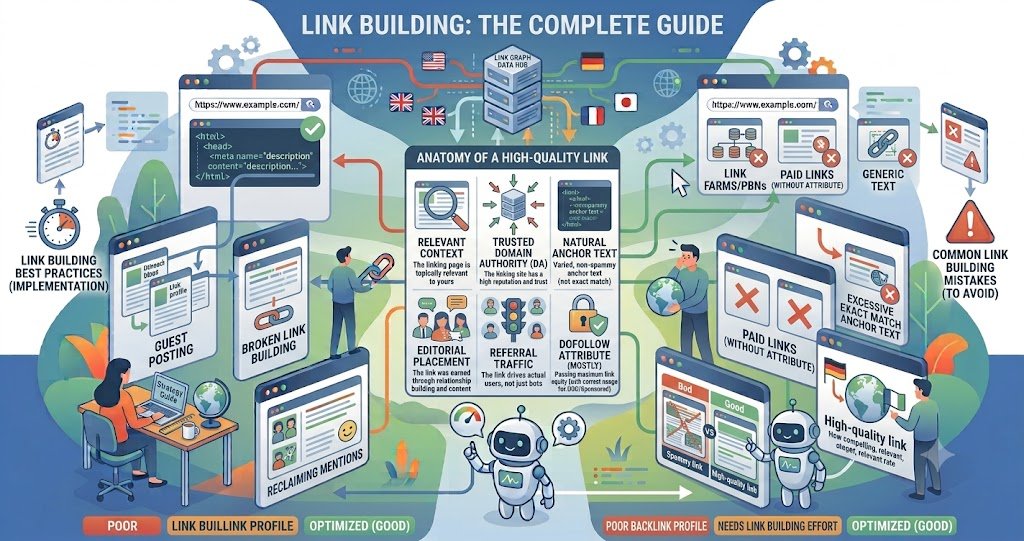
Link building remains one of the most debated yet consistently validated levers in SEO. Despite years of algorithm updates and the rise of AI-driven search, backlinks continue to rank among Google’s top three ranking factors, and pages sitting in the #1 spot carry roughly 3.8x more backlinks than those in positions 2–10, based on Backlinko’s analysis of 11.8 million search results. This guide breaks down what link building means today, why it still matters, and how to do it effectively in 2026.
Table of Contents
- What Is Link Building?
- Key Takeaways
- Why Links Still Matter in 2026
- Types of Backlinks
- Proven Link Building Strategies
- Link Building Costs and Benchmarks
- Common Mistakes to Avoid
- Conclusion
- FAQs
Key Takeaways
- Backlinks remain a top-three Google ranking factor, though their statistical weight has softened — one large-scale ranking factor study found their share dropped from roughly 27% in 2024 to 22% in 2025.
- Referring domains (unique linking websites) correlate more strongly with rankings than raw link count.
- The vast majority of content earns zero links: Ahrefs’ Content Explorer data shows around 94–95% of pages get no external backlinks at all.
- Digital PR and relationship-based outreach now outperform traditional guest posting and cold email, which converts on only about 8–9% of attempts.
- Agencies now allocate roughly 28–32% of total SEO budgets to link acquisition, and average cost per quality link has climbed past $500.
- Links continue to influence AI-driven search results and citations, not just traditional rankings.
Why Links Still Matter in 2026
Google has repeatedly said links carry less weight than they once did, but multiple independent datasets — Ahrefs, Backlinko, and Semrush among them — still show a consistent pattern: pages with stronger backlink profiles tend to rank higher. Referring domains, not total link volume, show the strongest correlation with organic visibility. Links also increasingly shape how AI systems like Google’s AI Overviews select and cite sources, meaning link equity now feeds both classic SEO and generative search visibility.
Types of Backlinks
- Editorial links — earned naturally when other sites cite your content as a resource.
- Guest post links — placed within contributed articles on third-party sites.
- Digital PR links — earned through media coverage, data studies, or expert commentary.
- Resource/directory links — listings on curated industry or local resource pages.
- Nofollow/UGC links — don’t pass full ranking value but still support brand visibility and referral traffic.
Proven Link Building Strategies
1. Digital PR and Data-Driven Content
Original research, surveys, and data studies attract organic citations from journalists and bloggers — this has overtaken guest posting as the top-performing tactic among SEO professionals surveyed in 2026.
2. Skyscraper and Resource Content
Publishing more comprehensive, current versions of already well-linked content gives outreach targets a clear reason to link.
3. Targeted Outreach and Relationship Building
Personalized, relevant pitches convert at meaningfully higher rates than mass cold email, which typically converts under 10% of the time.
4. Unlinked Mention Reclamation
Finding existing brand mentions without a link and requesting one is a low-cost, high-conversion tactic since the relationship already exists.
5. HARO-style Expert Contributions
Providing expert commentary to journalists and publications remains a reliable source of high-authority editorial links.
Link Building Costs and Benchmarks
Costs have risen sharply in recent years. Industry benchmarking studies now put the average cost per quality backlink above $500, up significantly from prior years, driven by tighter editorial standards and increased competition for placements. Most SEO teams treat link building as an ongoing budget line rather than a one-time project, with spend concentrated on digital PR and content-led campaigns over volume-based outreach.
Common Mistakes to Avoid
- Chasing link volume instead of relevance and domain quality
- Relying solely on cold outreach with generic templates
- Ignoring anchor text diversity and over-optimizing exact-match anchors
- Buying links from low-quality, clearly manipulative networks
- Treating link building as a one-off project instead of a continuous process
Conclusion
Link building hasn’t disappeared — it has matured. The tactics that worked in 2018 (mass guest posting, cheap directory submissions) now carry real risk, while relevance, editorial trust, and originality drive results in 2026. Referring domains, not raw link counts, remain the strongest predictor of ranking performance, and increasingly, of visibility in AI-generated answers too. A sustainable strategy blends digital PR, high-quality content, and genuine outreach relationships over shortcuts.
Frequently Asked Questions
Is link building still important in 2026? Yes. Backlinks remain a top-three ranking factor, and most SEO professionals expect links to stay relevant for years to come.
How many backlinks do I need to rank? There’s no fixed number — quality and relevance of referring domains matter more than raw count.
Are nofollow links worthless? No. They don’t pass full ranking value but still drive referral traffic and brand signals.
What’s the fastest way to build links? There’s no true shortcut; digital PR and reclaiming unlinked mentions tend to produce results faster than cold outreach.
Is buying links safe? No. It violates Google’s guidelines and risks manual penalties.