Redirects Explained (301, 302, 307 & 308)
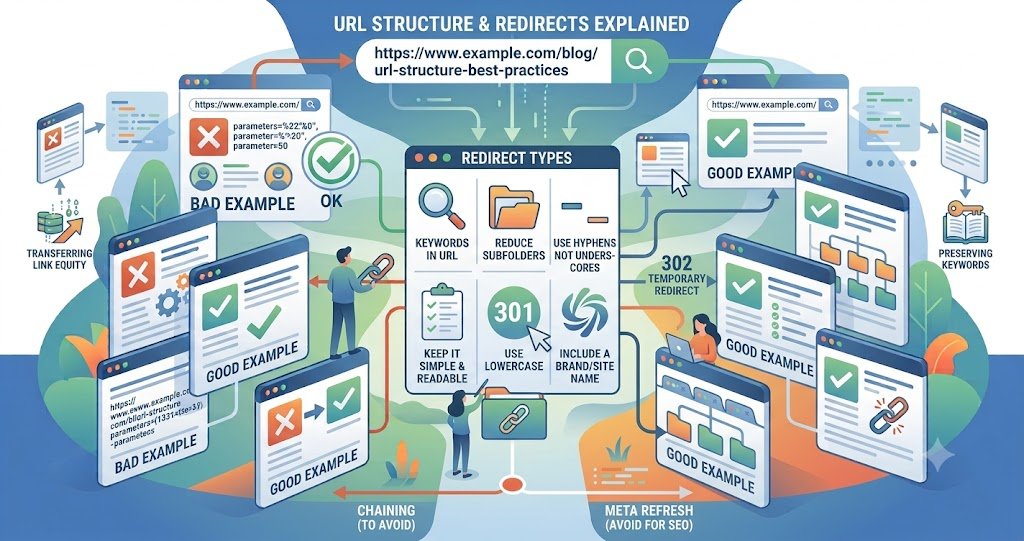
Redirects tell browsers and search engines that a URL has moved. Used correctly, they preserve rankings, protect user experience, and keep link equity flowing. Used incorrectly, they can silently bleed traffic, dilute crawl budget, and confuse Google about which URL to index. This guide breaks down the four redirect types every SEO and developer should understand: 301, 302, 307, and 308.
Table of Contents
- Key Takeaways
- What Is a Redirect?
- 301: Permanent Redirect
- 302: Temporary Redirect
- 307: Temporary Redirect (Strict)
- 308: Permanent Redirect (Strict)
- Choosing the Right Redirect
- Conclusion
- FAQs
Key Takeaways
- 301 and 308 are permanent redirects; they pass link equity and signal Google to update its index to the new URL.
- 302 and 307 are temporary redirects; they should preserve the original URL in search results while traffic is routed elsewhere.
- 307 and 308 are HTTP/1.1 additions that strictly preserve the request method (GET, POST, etc.), unlike 301 and 302, which browsers may convert to GET.
- Google treats 301 and 302 similarly for ranking purposes over time, but intent still matters for how quickly the index updates.
- Misusing temporary redirects for permanent moves is one of the most common technical SEO mistakes.
What Is a Redirect?
A redirect is an HTTP status code (in the 3xx range) that a server sends to tell a browser or crawler that a requested URL now points elsewhere. The code determines whether the change is treated as permanent or temporary, and whether the original HTTP method is preserved.
301: Moved Permanently
The 301 is the most widely used redirect in SEO. It tells search engines the resource has permanently moved to a new URL, and it consolidates ranking signals to the destination. Use it for domain migrations, HTTPS upgrades, URL restructuring, or merging duplicate pages. Google generally re-indexes the new URL and drops the old one over time, transferring the vast majority of accumulated authority.
302: Found (Temporary Redirect)
A 302 signals a temporary move. The original URL should, in theory, stay indexed since it’s expected to return. In practice, Google has confirmed it treats long-lived 302s much like 301s if the redirect persists over an extended period, but the safer practice is to reserve 302s for genuinely temporary situations, such as A/B tests, geo-based routing, or short-term promotions.
307: Temporary Redirect (Strict)
Introduced with HTTP/1.1, the 307 is functionally similar to a 302 but with one key difference: it strictly forbids the browser from changing the request method. If a form submission (POST) hits a 307, the redirected request stays a POST; under a 302, some browsers historically converted it to a GET. SEO-wise, 307 is treated the same as 302 by Google — temporary, not for permanent moves.
308: Permanent Redirect (Strict)
The 308 is the HTTP/1.1 counterpart to the 301, again preserving the original request method strictly. It’s commonly generated automatically by servers and frameworks (for example, when enforcing trailing slashes or HTTPS). Google treats 308 the same as 301 for indexing and link equity purposes.
Choosing the Right Redirect
| Scenario | Recommended Code |
| Permanent URL/domain change | 301 (or 308) |
| Site migration or HTTPS move | 301 |
| A/B testing or short campaign | 302 (or 307) |
| Maintenance page, temporary outage | 302 |
| Preserving POST data on redirect | 307 or 308 |
A practical rule: if the old URL should never be seen again, use a permanent redirect (301/308). If it will return, use a temporary one (302/307). The 307/308 pair matters most when the redirect involves form submissions or API calls where the HTTP method must not change.
Conclusion
Redirect codes aren’t interchangeable, even though browsers often render them the same way to end users. For SEO, the permanent-versus-temporary distinction directly affects how quickly and completely Google transfers ranking signals. For development, the strict method-preservation of 307 and 308 prevents broken form submissions and API calls. Auditing a site’s redirect chains periodically — and matching the code to actual intent — remains one of the simplest, highest-leverage technical SEO fixes available.
Frequently Asked Questions
Does a 302 redirect pass link equity like a 301? Google has stated that 302s can pass equity similarly to 301s if left in place long enough, but this isn’t guaranteed behavior, so permanent moves should always use a 301.
Is 308 better than 301 for SEO? Neither is “better” — both are treated as permanent redirects by Google. 308 is preferred only when method preservation matters technically.
Can too many redirects hurt SEO? Yes. Long redirect chains slow crawling, waste crawl budget, and can dilute signal transfer. Redirects should ideally point directly to the final destination.
Do redirects affect page speed? Yes, each redirect hop adds latency. Minimizing chains and using server-side (not JavaScript) redirects keeps load times faster.
Should I use a redirect or a canonical tag? Use a redirect when users should be sent to a different URL. Use a canonical tag when both URLs should remain accessible but only one should be indexed.