URL Structure Best Practices
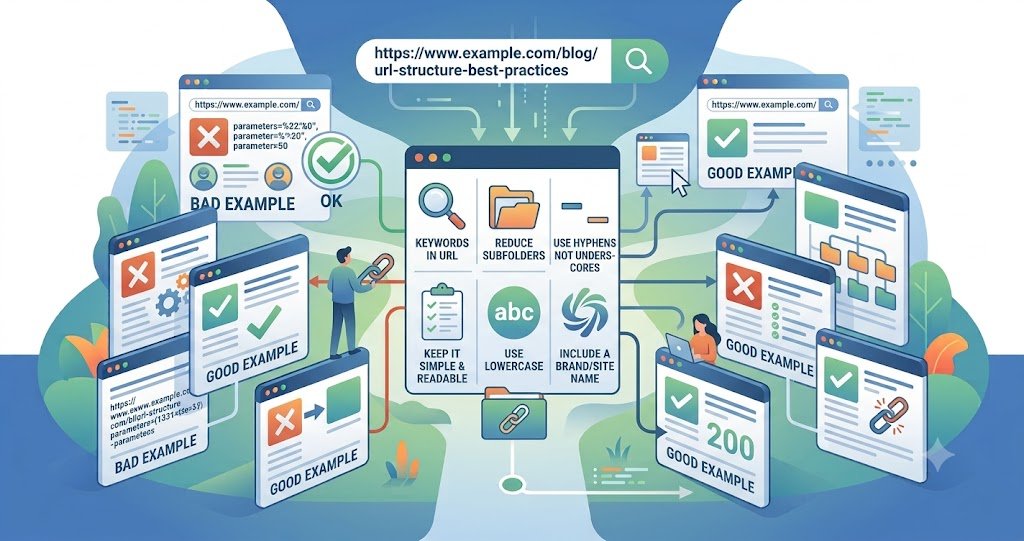
A URL is more than an address — it’s a ranking signal, a trust indicator, and a crawl instruction rolled into one string. Get the structure right, and you improve crawl efficiency, click-through rate, and how AI answer engines like Google AI Overviews cite your pages. Get it wrong, and you create duplicate-content sprawl that wastes crawl budget. This guide breaks down what actually matters in 2026, based on Google’s current Search Central documentation and recent industry data.
Table of Contents
- Key Takeaways
- What Makes a URL “SEO-Friendly”
- Core Structural Best Practices
- Technical Standards to Know
- Common Mistakes to Avoid
- Conclusion
- FAQs
Key Takeaways
- Google explicitly recommends simple, descriptive words over ID strings — URLs should be “intelligible to humans,” not just to machines.
- Keep slugs short: 3–5 words, hyphen-separated, lowercase, ideally under 75 characters.
- Subfolders (/blog/) consolidate authority; subdomains are treated as largely separate entities by Google.
- Google now expects URLs to comply with the IETF STD 66 standard (the modern codification of RFC 3986), meaning reserved characters must be percent-encoded rather than used literally.
- URL fragments (#) should never be used to deliver unique page content — Google Search doesn’t reliably index it. Use the History API instead.
- Overly complex URLs with many parameters can create near-duplicate URL explosions that burn crawl budget and dilute indexing.
- Backlinko’s analysis of roughly 4 million search results found URLs with a keyword matching the query earned meaningfully higher click-through rates than those without.
What Makes a URL “SEO-Friendly”
<cite index=”5-1″>Google’s own guidance is to keep site URL structure as simple as possible and to construct URLs logically, in a way that’s most intelligible to humans</cite> — not just crawlers. A well-formed URL tells a user what a page is about before they even click, and tells Google the same thing before it renders a single byte of body content.
Core Structural Best Practices
1. Use Words, Not IDs
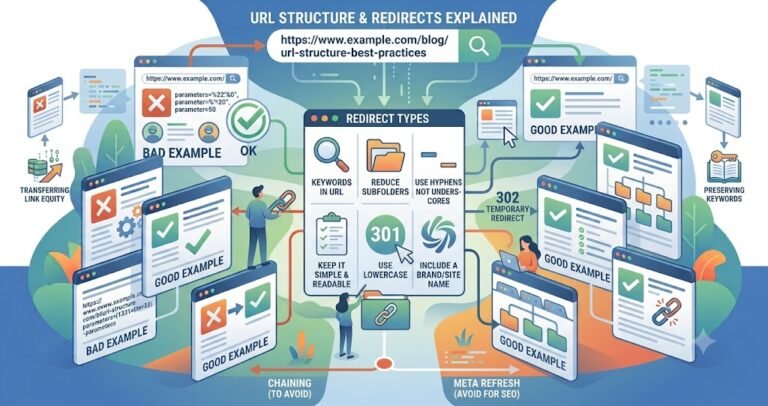
Avoid long numeric strings or database IDs in the path. /products/wireless-earbuds outperforms /products/id=48291 in both readability and topical clarity.
2. Hyphens, Not Underscores
Google parses hyphens as word separators; underscores can be read as a single joined token. Always use -.
3. Keep It Short and Flat
Aim for 3–5 words per slug and limit folder depth to roughly 2–4 levels. Shorter paths pass link equity more efficiently and are easier to share and remember.
4. Strip Stop Words — Carefully
Words like “the,” “and,” “of” can usually be dropped without losing meaning: /seo-audit-guide rather than /the-complete-guide-to-seo-audits. If removing a stop word makes the slug confusing, keep it — readability wins over brevity.
5. Choose Subfolders Over Subdomains
example.com/blog/ consolidates ranking signals under one root domain. blog.example.com is often treated as a distinct property, splitting authority unless there’s a hard technical reason to separate it.
6. Avoid Dates in Evergreen URLs
Baking a publish date into the slug (/2024/03/14/post-title) makes content look stale and forces a URL change — and a redirect — every time you refresh it.
7. Always Use HTTPS
HTTPS remains a confirmed baseline ranking signal, not optional infrastructure.
8. Redirect, Don’t Break
Whenever a URL changes, apply a 301 redirect and update internal links to point at the new destination directly rather than chaining redirects.
Technical Standards to Know
Google’s most recent Search Central update moved its URL guidance from the older RFC 3986 framing to explicit alignment with IETF STD 66, the current standard for URI syntax. Practically, this means reserved characters — spaces, certain symbols — must be percent-encoded rather than inserted literally, or sites risk crawl inefficiencies. Google has also reiterated that URL fragments (#section) should not be used to serve distinct content, since Search doesn’t reliably process them; JavaScript-driven content changes should use the History API instead so each state has a real, crawlable URL.
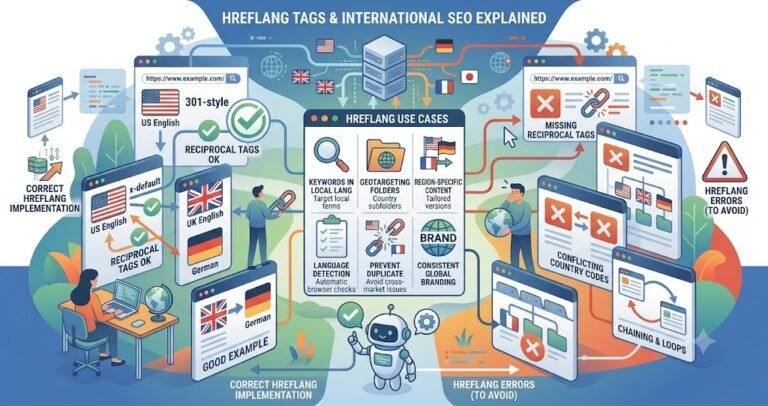
For international or multi-regional sites, subdirectories (example.com/de/) paired with correct hreflang implementation remain the recommended pattern over ccTLDs or subdomains for most sites.
Common Mistakes to Avoid
- Parameter sprawl: session IDs, tracking parameters, and faceted-navigation combinations that generate near-duplicate URLs at scale.
- Auto-generated slugs: permalinks pulled verbatim from long titles instead of a deliberately trimmed slug.
- Mixed case URLs: inconsistent casing can create duplicate-content issues since URLs are case-sensitive.
- No redirect strategy: restructuring a site without mapping old URLs to new ones.
Conclusion
URL structure isn’t a cosmetic detail — it’s infrastructure that touches crawl efficiency, indexing, click-through rate, and now visibility inside AI-generated answers. The core principles have stayed stable for years — short, descriptive, hyphenated, logically nested, HTTPS — but the technical compliance bar (percent-encoding, STD 66, no reliance on fragments) has gotten stricter. A periodic URL audit, especially before a site migration or CMS change, is one of the highest-leverage technical SEO tasks available.
Frequently Asked Questions
Q: How long should an SEO-friendly URL be? A: There’s no hard cap, but shorter URLs (under roughly 75 characters, 3–5 words in the slug) are consistently easier to read, share, and rank predictably.
Q: Do keywords in the URL still matter for rankings? A: They’re a minor signal, but the effect on click-through rate is more measurable — searchers are more likely to click a URL that visibly matches their query.
Q: Should I use subdomains or subfolders for a blog? A: Subfolders, in almost all cases. They keep authority consolidated under the root domain instead of splitting it across a separate crawlable entity.
Q: What happens if I don’t fix legacy URL parameters? A: Google may crawl and index near-duplicate variants of the same page, wasting crawl budget and potentially diluting ranking signals across duplicate URLs.
Q: Is changing an old URL structure worth the risk? A: Yes, if done with proper 301 redirects and updated internal linking — but avoid changing URLs without a migration plan, since it’s the most common cause of temporary ranking loss during restructures.