
Core Web Vitals: The Complete Guide
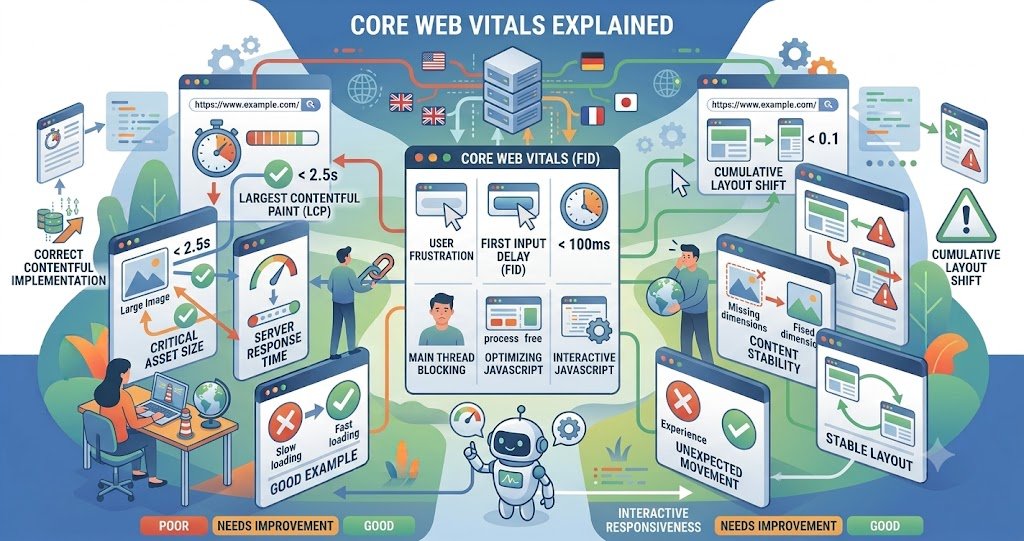
Core Web Vitals are Google’s three field metrics for measuring real-world page experience: loading speed, responsiveness, and visual stability. Since Interaction to Next Paint (INP) replaced First Input Delay (FID) in March 2024, these metrics have taken their current form. This guide breaks down what each one measures, the thresholds you need to hit, and how to fix common problems.
Table of Contents
- What Are Core Web Vitals?
- The Three Metrics and Their Thresholds
- How Google Measures Them
- How to Fix Each Metric
- Conclusion
- FAQs
Key Takeaways
- Core Web Vitals are three metrics: Largest Contentful Paint (LCP) for loading, Interaction to Next Paint (INP) for responsiveness, and Cumulative Layout Shift (CLS) for visual stability.
- Good thresholds are LCP under 2.5 seconds, INP under 200 milliseconds, and CLS under 0.1, each measured at the 75th percentile of real visits.
- Google evaluates these using real Chrome user data (CrUX), not lab tests.
- INP is the hardest metric to fix — LCP issues are usually about resources, CLS issues about missing dimensions, but INP is about JavaScript architecture.
- 43% of sites still fail the INP threshold, making it the most commonly missed vital.
- Core Web Vitals are one of many search ranking signals, alongside content quality and backlinks.
Main Content
1. What Are Core Web Vitals?
Core Web Vitals are a set of metrics introduced by Google to measure user experience on a web page, and they’ve been recognized as an official ranking signal since 2021. They aren’t the only ranking factor — content and backlinks still matter — but they can tip the balance in a competitive search results page.
2. The Three Metrics and Their Thresholds
Largest Contentful Paint (LCP) — measures how long the biggest visible element takes to load. A good score is under 2.5 seconds.
Interaction to Next Paint (INP) — measures how quickly the page responds to clicks, taps, and keypresses. It measures the time between a user’s interaction and when the browser can paint the next frame, with a threshold of 200 milliseconds. It replaced First Input Delay on March 12, 2024, and unlike FID, which only measured the first interaction, INP tracks all interactions and reports the worst one.
Cumulative Layout Shift (CLS) — measures unexpected visual movement on the page. A good score is under 0.1.
3. How Google Measures Them
To pass, at least 75% of visitors need a “good” score on each metric, based on real-world CrUX data at the URL level. If URL-level data isn’t available, Google falls back to broader URL-group or origin-level data. This data comes from a rolling 28-day window of real Chrome users, so a passing Lighthouse score in dev tools doesn’t guarantee a passing grade if real users on slower devices struggle. + 2
4. How to Fix Each Metric
Fixing LCP: Image preloading, inlining critical CSS, preloading fonts with font-display: swap, and server-side rendering are the highest-impact fixes.
Fixing INP: Any JavaScript task running longer than 50 milliseconds blocks the main thread, preventing the browser from responding to input. The fix requires breaking up long tasks, deferring non-critical work, and yielding to the main thread — a deeper architectural change than a quick patch.
Fixing CLS: Every image, video, iframe, and ad slot needs explicit width and height attributes, and reserved space for dynamic content eliminates most remaining shift sources.
Prioritization tip: fix whichever metric sits in the “poor” band first, then tackle INP, then LCP, then CLS — don’t spend time optimizing a metric that’s already green.
Conclusion
Core Web Vitals reward disciplined engineering, not clever workarounds: ship less JavaScript, reserve space for layout elements, and prioritize what users see first. Since Google measures real user data over a rolling window, improvements take a few weeks to show up in reporting — but the payoff for passing all three is a measurably better experience and a competitive edge in search.
FAQs
Do Core Web Vitals directly affect rankings?
They’re one ranking signal among many. A page can still rank well with imperfect vitals if content and authority are strong, but poor vitals can hold a good page back.
How often is Core Web Vitals data updated?
CrUX data updates on a rolling 28-day window, so changes take time to reflect after a fix ships.
What replaced FID, and when?
INP replaced First Input Delay as the official responsiveness metric on March 12, 2024.
Which metric is hardest to fix?
INP, because it requires changing how code handles interactions rather than simply compressing a file or adding an attribute.